
2026 Manufacturing: Order Books vs. Capacity
Your order book is growing faster than your ability to deliver against it. Unironically, that is actually a terrifying position to be in. For a growing number of manufacturers, it's already the stressful reality on the shop floor right now.
Winning the business is the easy part to celebrate. A full pipeline brings confidence and a great revenue picture. But the reality is that the contract doesn't solve your problems; it just triggers a whole new set of operational questions.
What would you classify as the win, the contract or the project delivery?
Between January and August 2026, VHR observed 31 major contract awards across Engineering & Manufacturing. Alongside them came a parallel wave of activity around supplier agreements and capacity investment. Organisations are not just competing to win the next programme. They are working out, often at the same time, whether the rest of the operation can actually support it once production starts to ramp.
Saab's Q2 numbers make the point well. Order bookings hit SEK 68.4 billion, including a SEK 47 billion submarine order to Poland, its largest export order to date. CEO Micael Johansson said the business was well positioned to meet demand while continuing to expand capacity ahead of higher delivery volumes. This means planning out your entire production footprint years before those new orders ever translate into real revenue.
Rheinmetall illustrates the gap between future demand and immediate liquidity, showing an order book of over €80 billion by June 2026 alongside a €1.6 billion cash deficit due to upfront production costs. This disparity demonstrates that a high volume of orders indicates strong potential, while negative cash flow reflects the heavy capital required to scale operations.
What does capacity actually mean?
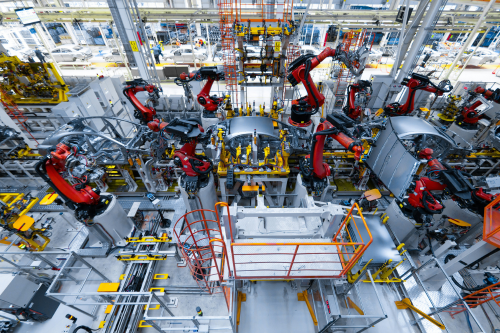
Capacity doesn't just mean more floor space and more machinery. A manufacturer can have all the floor space in the world and still be capped by a supplier that cannot lift volumes fast enough. When engineers are already maxed out, piling on another project just breaks the system. The extra work hits everyone one by one, from quality control to maintenance and planning. The truth is, your factory is only as fast as your bottleneck. If one team hits a wall, the whole output drops, no matter how good the rest of the business looks. That dynamic is echoed in recent operations research showing leading manufacturers now throttle capacity and redesign footprints to manage tier -1+ supply risk.
How much does a delay cost you?
Between January and August, we also observed 90 supply-chain partnership announcements across Engineering & Manufacturing. It shows that manufacturers are treating supplier capacity as a genuine constraint, not an assumption they can just leave unmanaged.
We all know a delayed part could hold up an order worth exponentially more than the component itself, completely halting an otherwise fully equipped production line. Even when backup options exist, the reality of lengthy qualification windows means switching suppliers isn't always a quick and simple fix. It's exactly why securing long-term supply agreements has become such a high priority right now. This is done so organisations can have a genuine capacity guarantee ahead of time.
Why hiring has to run ahead of production, not behind it
People follow a very similar timeline. In fact, finding the right talent often takes much longer than ordering new machinery or signing a supplier agreement. Scaling up production is never just a matter of hiring more operators for the line. In the real world, building out those specific professional capabilities takes a massive amount of time. In England alone, priority occupations in advanced manufacturing are projected to grow by 47,000 (13%) between 2025 and 2035, with roughly 101,000 replacements needed over the same period.
Waiting until the rush starts to bring in technical engineering or quality support just puts you behind the curve, hunting for talent when availability is lowest. Employers already report that more than a quarter of job vacancies are hard to fill due to skills shortages, with manufacturing among the sectors where those shortages remain stubborn. The challenge comes down to pinpointing the exact technical skills needed and dealing with the actual time it takes to secure that expertise today.
How VHR works with manufacturers managing this
VHR is a specialist technical recruitment consultancy with a dedicated practice in Engineering & Manufacturing. We support organisations hiring across design, quality, production and manufacturing engineering, on both permanent and contract bases, in markets where order books are currently outpacing available talent.
In practice, that means we maintain active candidate networks across the disciplines that take longest to fill, including production and manufacturing engineers, quality specialists, and programme engineers with experience scaling output on live contracts. These are consistently the roles where a strong order book turns into a real delivery risk if hiring starts too late.
If your organisation has roles that aren't moving, a production ramp on the 12 to 18 month horizon, or a workforce plan that needs testing against current market supply, get in touch with VHR's Engineering & Manufacturing team. The earlier that conversation starts, the more options it leaves you with.