
Why Counter-UAS Is Becoming a Defence Market of Its Own
Farnborough 2026 showed how the rapid growth of drones is creating an equally significant market for the systems designed to detect, disrupt and defeat them.
KEY TAKEAWAY
Counter-UAS is moving from a specialist capability to a core defence requirement. The commercial and operational race is increasingly about layered defence, sustainable cost per engagement, sovereign production capacity and the ability to manufacture systems at scale.
The rapid adoption of drones has reshaped the modern defence landscape. Recent conflicts have demonstrated how relatively inexpensive unmanned systems can be deployed in significant numbers, creating a threat that is as much an economic challenge as an operational one.
Farnborough International Airshow 2026 provided some of the clearest evidence of how quickly the industry is responding. Counter-Uncrewed Aircraft Systems, or Counter-UAS, are moving beyond a specialist defence capability and developing into a significant market in their own right.
The challenge defence leaders have is the ability to counter these inexpensive drones in a costly manner. Using an expensive traditional interceptor to destroy a comparatively inexpensive drone may be operationally effective, but it becomes increasingly difficult to sustain when threats arrive in significant numbers.
Traditional air-defence interceptors may be highly effective, but repeatedly using expensive missiles against comparatively low-cost drones creates an obvious imbalance. That problem becomes considerably more difficult when threats are deployed in large numbers, forcing defensive systems to respond again and again while also maintaining sufficient stock, production capacity and operational readiness.
This cost asymmetry is now helping shape the next generation of Counter-UAS technology.
How do defence organisations defeat large numbers of low-cost drones without spending disproportionately more to stop them?
What Farnborough 2026 Tells Us About the Counter-UAS Market
- Walk though the full report with VHR
Farnborough provided more than a showcase of new Counter-UAS technology. The announcements pointed towards a market moving rapidly from experimentation into procurement, production and deployment at scale.
Several developments stood out:
| Organisation | Development | Why it matters |
| MBDA | Counter Mass Interceptor | Designed for mass attacks by low-cost drones with affordability and high-volume manufacture central to the concept |
| Lockheed Martin | MORFIUS X-Rotor | Reusable airborne high-power microwave system designed to neutralise more than 50 hostile drone in one flight. |
| QinetiQ | HELENA / £20m investment | Investment is increasing development and production capacity for laser directed-energy technology at Farnborough and Malvern. |
| UK MOD / LCADE | Low-cost interceptor programme | £3.16m awarded to Cambridge Aerospace, Greenjets and Frankenburg Technologies to develop scalable low-cost air-defence effectors. |
| Cambridge Aerospace | Skyhammer | British interceptor programme progressing through contracts, testing and delivery for UK and Gulf requirements. |
5 Forces Changing the Economics of Counter-UAS
1. Cheap Drones Have Changed the Cost of Warfare
The UK Ministry of Defence highlighted this challenge when announcing its Low-Cost Air Defence Effectors programme, or LCADE, in July 2026.
The MOD described how increasing numbers of cheap, mass-produced drones can place pressure on traditional air-defence systems that are typically more expensive and slower to manufacture.
2. Cost Per Engagement Is Becoming a Defence Metric of Its Own
CSIS estimates cited within the research place Shahed-type drones at approximately $20,000-$50,000 each.
By comparison, modern surface-to-air interceptors can cost several hundred thousand dollars or considerably more.
Other industry estimates place Shahed-class threats at around $15,000-$50,000, while some have reportedly been engaged using interceptors costing between approximately $1 million and $12 million.
3. Lower-Cost Interceptors Are Beginning to Change the Equation
Reuters reported in April 2026 that some Ukrainian interceptor drones cost less than $1,500, compared with an estimated $35,000 to manufacture a Shahed-type attack drone.
4. Defence Manufacturers Are Designing for Scale
At Farnborough International Airshow 2026, MBDA unveiled its Counter Mass Interceptor, developed specifically for saturation attacks involving large numbers of lower-cost drones and other airborne threats.
Rather than relying exclusively on conventional missile-production models, MBDA is examining techniques closer to high-volume automotive manufacturing, with affordability and the ability to manufacture considerably greater quantities forming part of the concept.
5. One Interceptor for Every Drone May Not Be Sustainable
Lockheed Martin is approaching the same economic challenge from a different direction.
Its MORFIUS X-Rotor uses a high-power microwave payload designed to engage multiple drones rather than expending an individual interceptor against every target.
Lockheed Martin states that the system can neutralise more than 50 hostile drones during a single flight before being recovered and reused in the field.
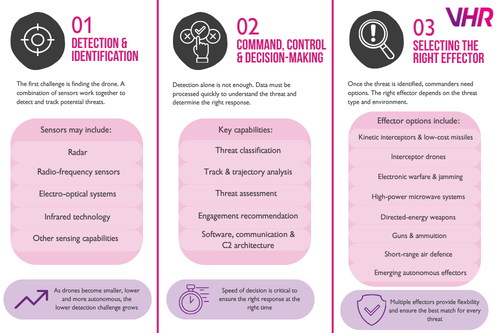
Counter-UAS is unlikely to be dominated by a single technology because the threat itself is too diverse. Small quadcopters, long-range one-way attack drones and coordinated swarms each present different challenges, while the most appropriate response also depends on the operational environment. This is why layered defence is becoming increasingly important, combining detection, decision-making and a range of effectors so defence organisations can apply the right response to the right threat.
Directed Energy Could Change the Economics Further
One of the most significant areas of Counter-UAS investment is directed energy. The appeal goes beyond cost alone. Laser systems could give defence organisations another way to respond to repeated drone attacks while reducing dependence on finite stocks of conventional interceptors.
Some of my thoughts:
1. Greater Magazine Depth Could Help Defence Respond at Scale
QinetiQ is a good example. During Farnborough they highlighted near-infinite magazine depth as one of the potential advantages of high-energy laser systems. Unlike a conventional interceptor launcher, which is ultimately constrained by the number of missiles immediately available, a laser system can potentially continue engaging targets while sufficient power and suitable operating conditions remain available.
They also announced £20 million of company-funded investment to accelerate the development and production of high-energy laser technology. The company also unveiled its HELENA family of high-energy laser source products and confirmed that production capability is being expanded at its Farnborough and Malvern sites.
2. Directed Energy Adds Another Layer, Rather Than Replacing Everything Else
Laser systems wont be the ‘one shot handles all’ to drone threats, however its long-term value may sit within a layered Counter-UAS architecture.
Directed energy could provide one response, while interceptor drones, electronic warfare, kinetic interceptors and other effectors remain available when a different approach is required.
Other statements continuation
- Cambridge Aerospace's Skyhammer provides a clear example. The British-developed interceptor is designed to counter Shahed-style attack drones. The UK Government confirmed in April 2026 that Skyhammer and its launchers were set to be supplied to the UK Armed Forces and Gulf partners, followed by successful testing in Jordan announced in May.
- The Ministry of Defence awarded £3.16 million to Cambridge Aerospace, Greenjets and Frankenburg Technologies to develop low-cost interceptors, with each company committing to build manufacturing capability in the UK. The wider LEAP initiative brings together the UK, Poland, France, Italy and Germany around affordable effectors and autonomous platforms.
Counter-UAS Will Require a Broad Technical Workforce
The expansion of Counter-UAS also creates a significant workforce requirement. The market brings together specialist disciplines that have traditionally operated across different parts of defence technology.
If Counter-UAS programmes expand simultaneously across the UK, Europe, North America and the Middle East, competition for specialist engineering, manufacturing and programme talent could become another constraint on how quickly industry can respond.
RF and Electronic Warfare Engineers: Developing technology capable of detecting, identifying, disrupting and defeating communications and control links.
Radar and Sensor Engineers: Designing systems capable of identifying increasingly small, low-flying and difficult-to-detect targets.
Systems Engineers: Connecting sensors, command systems and effectors into a single operational architecture.
Embedded Software and Autonomy Engineers: Supporting autonomous detection, tracking, decision-making and interception.
Electronics Engineers: Developing hardware required across sensors, communications and effectors.
Directed-Energy Specialists: Supporting high-energy laser and high-power microwave development.
Mechanical and Manufacturing Engineers: Taking new interceptor technologies from development into scalable production.
Test and Validation Engineers: Recreating evolving drone threats and validating performance in complex environments.
Quality and Production Professionals: Ensuring systems can be manufactured repeatedly and reliably as production volumes increase.
Programme and Supply-Chain Specialists: Coordinating rapidly changing requirements across suppliers, production programmes and defence customers.
Sources and Further Reading
- Reuters - MBDA unveils interceptor to counter mass drone attacks (20 July 2026)
- Lockheed Martin - MORFIUS X-Rotor unveiled at Farnborough (20 July 2026)
- QinetiQ - £20m investment in HELENA high-energy laser technology (20 July 2026)
- UK Government - UK leads Europe with contracts for low-cost air defence systems (13 July 2026)
- UK Government - Skyhammer supply to UK military and Gulf partners (10 April 2026)
- UK Government - Skyhammer successfully tested in Jordan (1 May 2026)
- Farnborough International Airshow - Drone & Counter-Drone Warfare: Lessons from Ukraine to the Middle East
- Reuters - Farnborough opens with air-defence focus (20 July 2026)
- UK Ministry of Defence – Low-Cost Air Defence Effectors (LCADE)
- Defense News – Cost per engagement / Latvia Counter-UAS testing