

Satellites by Country in 2026
At VHR, we support organisations operating at the forefront of aerospace, aviation, defence, and emerging space technologies. As satellite constellations continue to expand, the demand for highly skilled engineers, avionics specialists, systems integration professionals, and satellite communications experts is increasing rapidly. This growth is creating significant opportunities for both employers and candidates across the global aerospace sector.
The global satellite industry has entered a new era with government agencies, commercial operators, defence organisations, and private companies launching spacecraft at an unprecedented rate. However, one name continues to stand above all others: Starlink.
Starlink: The Largest Satellite Constellation Ever Built
Operated by SpaceX, Starlink has transformed the satellite industry through the deployment of thousands of low Earth orbit (LEO) satellites designed to provide global broadband internet coverage.
As of 2026, Starlink accounts for the majority of active satellites currently operating in orbit, making it the world's largest satellite constellation by a considerable margin.
Key Starlink facts:
- More than 8,000 satellites have been launched since the programme began.
- Thousands of satellites are currently operational in low Earth orbit.
- The constellation provides internet services to users across multiple continents.
- Starlink satellites orbit at approximately 550 km altitude, significantly lower than traditional geostationary communications satellites.
- The network continues to expand through regular Falcon 9 launches.
Further information can be found through official Starlink updates from:
The growth of Starlink has driven demand for specialists in:
- Satellite communications engineering
- Aerospace manufacturing
- Space systems integration
- Software engineering
- RF engineering
- Ground station operations
- Satellite testing and verification
This trend highlights the increasing importance of specialised aviation recruitment and aerospace recruitment services capable of sourcing talent for rapidly expanding space programmes.
Active Satellites by Country in Orbit
While Starlink dominates the global satellite market, nations around the world continue to expand their own space capabilities.
Approximate active satellite ownership by country and operator:
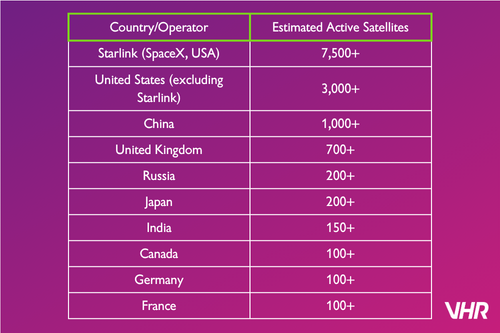
Satellite numbers change frequently as new launches occur and older satellites are retired.
Why Are Countries Launching More Satellites?
Several factors are driving the rapid expansion of satellites in orbit.
Communications and Connectivity
The demand for high-speed internet connectivity is one of the biggest growth drivers. Satellite internet services now support remote locations, maritime operations, military deployments, and commercial aviation.
This development is also influencing aircraft connectivity programmes, where next-generation satellite systems are enabling enhanced passenger experiences and operational efficiencies.
Learn more about aviation connectivity from VHR's guide to fleet digitalisation: VHR Guide to Fleet Digitalisation
Earth Observation
Satellites monitor weather systems, environmental conditions, agriculture, infrastructure, and disaster response efforts.
Earth observation data has become essential for governments, research institutions, airlines, and logistics operators seeking greater operational visibility.
Defence and Security
Many countries now view space as a strategic domain. Defence organisations increasingly rely on satellites for communications, surveillance, navigation, and intelligence gathering.
As a result, satellite engineering skills are becoming highly sought after across military aerospace programmes worldwide.
Navigation Services
Satellite positioning systems continue to underpin global transportation.
Examples include:
- GPS (United States)
- Galileo (European Union)
- BeiDou (China)
- GLONASS (Russia)
- NavIC (India)
Without these systems, modern aviation operations would be significantly more challenging.
The Growing Demand for Satellite Engineering Talent
The expansion of satellite networks has created a highly competitive labour market.
Many aerospace organisations face challenges recruiting professionals with experience in:
- Spacecraft design
- Structural engineering
- Systems engineering
- Mission operations
- Software development
- Avionics
- RF communications
- Satellite manufacturing
- Aerospace quality assurance
This skills demand extends across both commercial aerospace and defence sectors.
VHR has extensive experience supporting aerospace and aviation organisations with specialist workforce solutions across more than 59 countries. Our global aerospace recruitment teams work closely with employers to identify skilled engineering professionals capable of supporting complex satellite and space technology projects.
As commercial spaceflight, satellite manufacturing, and launch operations continue to expand, demand for highly qualified technical personnel is expected to remain strong throughout the decade.
What the Future Holds for Satellites
The next phase of satellite development is expected to focus on:
- Higher-capacity broadband constellations
- Direct-to-device communications
- Advanced Earth observation systems
- Artificial intelligence-enabled satellite operations
- Sustainable space operations
- Improved space debris management
As countries and private operators continue investing in orbital infrastructure, satellites will play an increasingly important role in communications, aviation, defence, and global connectivity.
The organisations that can successfully attract, develop, and retain specialist aerospace talent will be best positioned to lead this transformation.